- Concept
- Choose your journey
Which journey should I choose?
Last updated: September 29, 2026
Three roles operate Liquibase Secure. Each has a quick start.
Liquibase Secure is operated by three roles, and each has its own path through the documentation. Pick the one that sounds like you.
Administrator
You stand up Liquibase Secure and keep it running: deploy the server, add the license, connect Secure Automation, and verify operational data is flowing. Start with the Administrator Quick Start.
Project owner or governance owner
You define what is governed and watch how it performs: organize projects, pipelines, and database connections, choose and assign the policies, and act on the results. Database platform owners usually start here too. Start with the Project Owner Quick Start.
Developer
You author database changes and ship them through the pipeline, with governance enforced automatically and feedback returned in your own tools. Start with the Developer Quick Start.
A fourth journey, for compliance and audit stakeholders who verify rather than configure, arrives with the compliance capability.
Implementing Liquibase Secure for the first time?
Work through the path in order the first time: plan your implementation, install, structure your changelog, connect your database, build your automation, and define your policies. If you are picking up an implementation that is already underway, go straight to the step you are on. The planning pages are Build your implementation team below and Review your scope and infrastructure at the start of Create and deliver database changes; the rest lives in Create and deliver database changes and Govern database changes.
A sample implementation repository is available with working changelogs, flow files, and pipeline definitions for both GitHub Actions and Azure DevOps, including a script that spins up three local PostgreSQL databases so you can run the whole reference pipeline before touching a real one.
Build your implementation team
Implementation goals
Before you begin assembling your team and building your design, review the objectives and success criteria for your implementation. Your organization may have specific goals, such as:
Automating database migrations and allowing developers to self-service
Maintaining version control of schema changes
Incorporating the database into existing CI/CD pipelines
Ensuring consistent, reliable, and secure database deployments
Refer to the objectives to measure your success and track your team's achievements.

Building the team
To implement a performant change management strategy that enforces code and data quality standards, there are three stakeholders that are key to success:
DevOps lead. Provides automation support during the Liquibase implementation and ensures the new automation system follows DevOps best practices.
Database administrator lead. Provides database support during the Liquibase implementation and ensures database best practices are used in the new automation system.
Lead developer or data lead. Provides the development perspective for the new automation process, and acceptance testing of the new solution to ensure it satisfies the development needs.
Roles and responsibilities
From the outset of your implementation, planning how teams will interact with Liquibase Secure features and automation is crucial. Developing usage guidelines will help ensure that changes are applied smoothly and consistently.
This planning process will also reveal where system integrations are needed and identify additional training areas.
The automation team
This team specializes in developing the CI/CD automation framework. Their aim is to enable application and data teams across the organization to independently manage and deploy their database changes. The setup and onboarding processes should be thoroughly documented and seamlessly integrated with existing application delivery workflows.
The application or data team
The ideal implementation team should consist of a development or data team and a lead developer (or data lead). The project scope and requirements should consider the applications, databases, and environments utilized by this team. Additionally, considerations for scalability and future rollouts should include other teams, applications, and database types.
Scope of the first implementation
The scope of the first implementation should encompass the databases the application team (or the data team) utilizes.
This involves gathering requirements to compile a comprehensive list of databases, environments, and schemas involved.
Security requirements
Identifying all database security requirements is a critical step in the first phase of the implementation. Credentials must be stored in vaults or secured by another mechanism. Personal Identifiable Information (PII), the Health Insurance Portability and Accountability Act (HIPAA), and other data protection standards must be followed. Consult with your security team to ensure your implementation plan adheres to all data privacy compliance regulations for your organization.
Sample team workflow
Below is a sample workflow diagram illustrating the likely steps for team members when using Liquibase Secure.
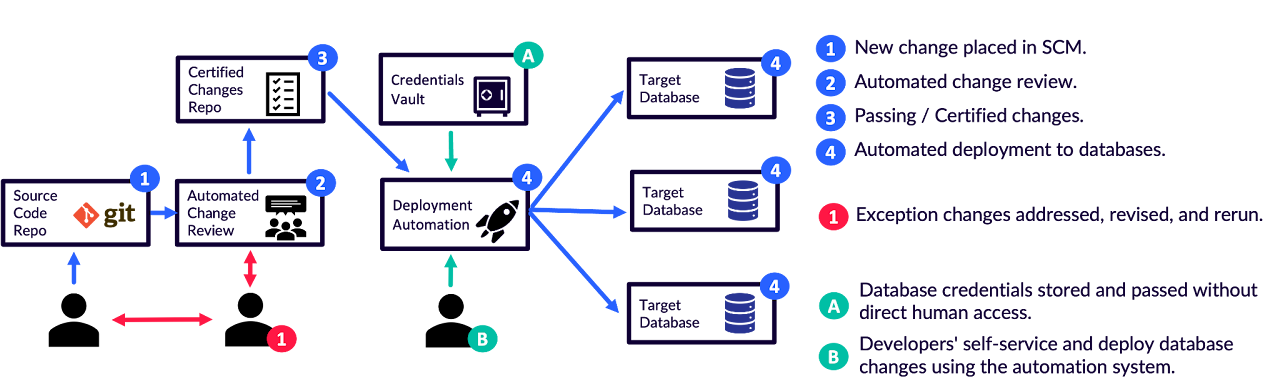
Agree who decides what
The three roles each own a class of decision the other two cannot make well. The database administrator lead cannot decide what your pipeline looks like, and the DevOps lead cannot decide which SQL patterns are unacceptable in production.
Agree up front who has final say where those overlap. In practice the contested decision is almost always what happens when a policy check fails on a change the developer believes is correct. Decide the escalation path during planning, not during your first blocked release. Policy check roll out best practices covers how to vary severity by environment, which is usually the mechanism the answer takes.
How these roles map to Liquibase Secure 6.0
Each implementation role has a direct counterpart in how the product is operated day to day, and each has a quick start under Choose your journey in Get started.
The DevOps lead becomes the administrator. Deploy the server, add the license, connect Secure Automation, and keep the platform healthy.
The lead developer follows the developer journey. Create, validate, and deliver changes, and respond to governance feedback in your own tools.
The database administrator lead typically becomes the project owner or governance owner. Organize projects, pipelines, and database connections, choose and assign the policies, and act on what the results show.
In a small team one person can hold more than one journey. The mapping matters more than the headcount: every class of decision needs a named owner.